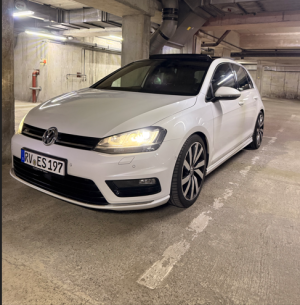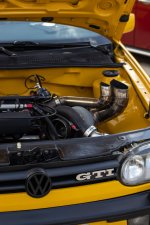
Photo by Affonso Jr via Pexels
Pop the hood on a Golf GTI, an Audi A3 and a Škoda Octavia and you'll notice something strange: half of what you're looking at is the same part.
That's not a coincidence. It's the entire business model.
Volkswagen Group builds more brands than almost anyone else in the industry — Volkswagen, Audi, Škoda, SEAT, CUPRA, Porsche, and beyond. It could never afford to engineer each of them from a blank sheet of paper. So it doesn't. Instead, it builds a small number of shared architectures and lets dozens of different cars grow out of them.
Understanding those platforms — MQB, MLB, and MEB — explains almost everything about how a modern VAG car is designed, priced, repaired and modified.
What "Platform Sharing" Actually Means
A platform isn't just a floor pan. It's a standardized kit of hard points, suspension mounting geometry, wiring architecture, pedal box position and crash structure that many different models can be built around.Two cars on the same platform can have completely different sheet metal, completely different badges, and completely different price tags — while sharing suspension geometry, engine mounting points, and a huge percentage of their electronics underneath.
This is why an Audi TT and a VW Golf R have so much in common mechanically despite looking nothing alike. It's also why a fault code, a coding change, or a suspension upgrade discovered on one platform-mate so often transfers cleanly to another.
MQB: The Backbone of the Group
MQB (Modularer Querbaukasten, or "modular transverse matrix") is the single most important platform Volkswagen Group has ever built. Introduced in the early 2010s, it underpins transverse, front-engine cars across nearly every brand: Golf, Passat, Tiguan, Audi A3, Audi Q3, Škoda Octavia, SEAT Leon, and many more.MQB standardized something genuinely radical: the distance between the front axle line and the pedal box stays fixed across the whole family, regardless of the car's overall length or engine size. Everything else — wheelbase, track width, engine choice — can flex around that one fixed point.
The payoff is enormous. A three-cylinder engine and a powerful turbocharged four-cylinder can be built on the same line, in the same plant, sharing the same suspension pick-up points and much of the same wiring harness logic. That's part of why VCDS and OBDeleven coding options so often look similar across completely different-looking cars — underneath, they're closer relatives than their badges suggest.

Photo by Artem Podrez via Pexels
MLB: Where the Premium Brands Live
While MQB handles the high-volume transverse cars, MLB (Modularer Längsbaukasten, "modular longitudinal matrix") was built for longitudinal-engine, typically higher-end vehicles — mostly Audi (A4, A6, Q5, Q7) and several Bentley and Lamborghini models.MLB's defining trait is that the engine sits front-to-back rather than side-to-side, which is what makes quattro-style all-wheel-drive layouts and larger six- and eight-cylinder engines possible without redesigning the car from scratch. It's a different set of engineering priorities from MQB: more room for driveline hardware, more headroom for power, and architecture built around brands that compete on refinement as much as efficiency.
MQB and MLB rarely mix — and that's exactly the point. Each platform is optimized for a different job, which is why a Golf and an A6 don't feel like they're wearing the same underwear, even though both are, in the loosest sense, "VAG platform cars."
MEB: The Electric Chapter
MEB (Modularer E-Antriebs-Baukasten, "modular electric drive matrix") is the newest of the three, and it throws out the combustion-era assumptions entirely. There's no transmission tunnel to route around, no need to package an engine over or ahead of the front axle, and no exhaust system to run underneath.Instead, MEB is built around a flat battery pack in the floor, a compact electric motor at one or both axles, and a short front structure that exists mainly for crash safety rather than housing an engine. That's the architecture underneath the ID.3, ID.4, ID.7, Audi Q4 e-tron, Škoda Enyaq and CUPRA Born.

Photo by Mohamed B. via Pexels
The practical result for owners: MEB cars diagnose and code differently from MQB/MLB cars in some fundamental ways. Battery management, motor control and thermal systems replace fuel trims, injector coding and turbo boost tables. If you're coming from a TSI background, the diagnostic mental model has to shift, even if the VCDS/OBDeleven workflow feels familiar.
Why This Actually Matters For Owners
None of this is trivia. It has direct, practical consequences:- Parts and upgrade compatibility often follows the platform, not the brand — a suspension component designed for one MQB car frequently fits several others.
- Common faults tend to appear across an entire platform family rather than a single model, which is exactly why forums built around VCDS/OBDeleven diagnostics are so valuable — the same code shows up on an Octavia, a Leon and a Golf.
- Resale and modification culture cluster around platforms. Knowing whether a car is MQB, MLB or MEB tells you almost immediately what kind of aftermarket support, tuning potential and shared knowledge base exists for it.
The next time you're comparing a Golf to an A3, or wondering why a Škoda shares a fault code with a SEAT, remember: badge is marketing. Platform is engineering. And in the Volkswagen Group, the platform is almost always the real story.